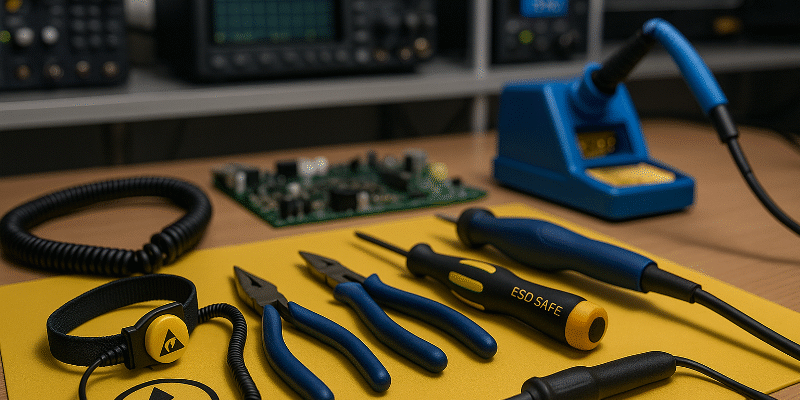
ESD standards production tools have become the backbone of modern battery and electronics manufacturing lines. Without a strong grounding in these standards, even the most advanced plants risk compromising sensitive components. As explained in the IECQ news portal on electrostatic control, ESD governance represents a global standard adhered to by nearly the entire electronics industry supply chain.
Electrostatic discharge (ESD) control is no longer a complementary practice; it is mandatory in environments where microelectronic devices, lithium batteries, and high-precision sensors are produced. Many manufacturers now integrate ESD-safe tooling at every stage, from raw material handling to final assembly. This creates not just protection, but also consistency in production outcomes. For a Karawang MRO supplier, keeping pace with these standards ensures reliability across client operations.
Beyond global best practices, the industry continues to innovate with more systematic approaches. As documented in a peer-reviewed research journal from the IEC platform, IEC 61340 has become a critical reference for designing tools, workspaces, and integrated electrostatic protection systems. This reinforces the view that without compliance with such standards, production sustainability is exceedingly difficult to achieve.
1. Understanding the Importance of ESD Standards
Preventing Costly Damages
ESD can cause immediate or latent failures in electronic components. By applying ESD standards production tools, plants avoid expensive product recalls, warranty claims, and production downtime.
Building Customer Confidence
Adopting international standards demonstrates credibility. For a Karawang industrial supplier , compliance reassures global clients that local facilities meet international benchmarks.
Enabling Scalable Operations
Once a plant is aligned with ESD standards, scaling production becomes more seamless. Expansion lines can replicate existing best practices without costly redesigns.
2. Core Principles Behind ESD-safe Tooling
Material Conductivity
Tools must be made of static-dissipative or conductive materials to safely redirect electrical charges.
Proper Grounding
From wrist straps to floor mats, grounding ensures charges are directed away from sensitive parts.
Controlled Environments
Humidity control and ionization equipment reduce charge build-up, aligning with ESD standards production tools frameworks.
Continuous Monitoring
Advanced facilities invest in ESD monitoring systems to ensure consistent performance across shifts.
3. Types of ESD-safe Production Tools
Hand Tools
Precision screwdrivers, pliers, and cutters designed with conductive handles.
Storage & Transport Systems
Conductive boxes and racks for safe component movement across assembly lines.
Measuring & Testing Equipment
Devices calibrated to avoid static charge accumulation.
Protective Wearables
Gloves, lab coats, and footwear tested for compliance with ESD standards.
4. ESD Standards Across Global Supply Chains
IEC Standards
IEC 61340 guides global practices in production and storage.
ANSI/ESD S20.20
Adopted widely in North America, forming part of contractual obligations in electronics sourcing.
OEM-specific Standards
Automotive and aerospace companies often add stricter ESD requirements.
Regional Adaptations
Asian markets adapt ESD control within localized compliance, supporting industrial chemical distributor Karawang to align chemical usage with static-sensitive environments.
5. Challenges in Implementing ESD-safe Tooling
Cost Factors
Initial investments for ESD tooling can be high, especially for SMEs.
Training Needs
Operators must be trained to consistently follow ESD procedures.
Auditing and Compliance
Regular audits are necessary to maintain certification.
Supply Chain Integration
Sourcing ESD-compliant tools from a trusted supplier of engineering equipment & tools Karawang is critical to avoid gaps in compliance.
6. Frequently Asked Questions (FAQ)
What industries require strict ESD standards?
Electronics, automotive, aerospace, and renewable energy manufacturing lines.
Are ESD standards mandatory?
Yes, most clients and global supply chains enforce compliance through contracts.
How often should tools be tested?
Quarterly testing is common, though high-risk environments may require monthly checks.
Can regular tools be adapted for ESD compliance?
Some tools can be retrofitted, but purpose-built ESD-safe tooling is more reliable.
Does PT Duta Swarna Dwipa provide ESD-safe solutions?
Yes, as a Karawang safety tool supplier, we provide tailored ESD-safe solutions for diverse industries.
7. HowTo: Implementing ESD-safe Tooling in Production Lines
- Assess production areas for ESD risks.
- Source ESD-safe tools and protective wear.
- Train operators on proper handling and grounding.
- Install continuous monitoring devices.
- Schedule periodic audits to maintain compliance.
8. Comparison Table of ESD Standards
| Standard | Region | Key Features | Typical Users |
|---|---|---|---|
| IEC 61340 | Global | Comprehensive ESD protection framework | Electronics, battery plants |
| ANSI/ESD S20.20 | North America | Process control, testing, and certification | Aerospace, automotive |
| OEM Standards | Global | Stricter proprietary rules | Tier-1 suppliers |
| Local Standards | Asia/Europe | Adapted compliance levels | Regional SMEs |
9. Moving Forward with Trusted Partners
At PT Duta Swarna Dwipa, we acknowledge that our journey toward ideal compliance with ESD standards production tools may not yet be perfect. However, we continuously improve and upgrade our practices to serve you better. As a B to B procurement supplier for MRO industrial needs throughout Indonesia, officially registered with AHU, we are committed to providing reliable solutions.
Wherever you are in Karawang, our team will gladly visit and discuss your specific needs. Please do not hesitate to contact us or use the WhatsApp button at the bottom of our website page. Together, let’s ensure your production lines are safe, efficient, and future-ready.