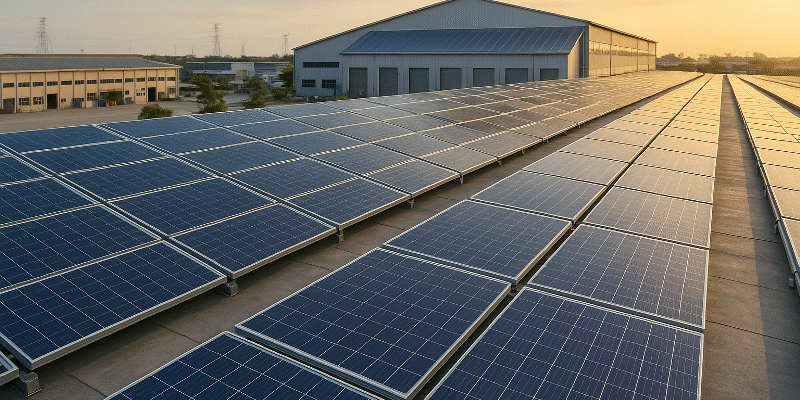
Latest rooftop solar rules are changing the way industries in Java assess investment returns and energy planning strategies. According to details published from the pv-magazine news portal, PLN has set quotas for rooftop solar installations through 2028, directly influencing how businesses forecast capacity and manage operational budgets. For manufacturers and industrial suppliers across Karawang and beyond, this policy shift requires fresh analysis of financial models and sustainability roadmaps.
The new framework goes beyond technical regulations—it reshapes corporate decision-making. Companies that once relied on conventional energy cost assumptions must now account for capped quotas, evolving tariff structures, and emerging carbon responsibility trends. For a Karawang MRO supplier, aligning product portfolios and services with clients’ sustainability goals becomes a strategic necessity. Rooftop solar is no longer just an energy option—it’s a competitive driver in supply chain partnerships.
This direction is also reinforced by academic studies. One key scientific research journal from the IEOM Society platform highlights how industrial energy efficiency and renewable integration can strengthen long-term competitiveness. For industries in Java, the convergence of government policy, market incentives, and scientific validation signals a new era of calculated energy transition.
1. Understanding the Rooftop Solar Quotas
Policy framework
The rooftop solar quotas define how much capacity can be connected to the grid annually until 2028. This framework gives industries a clear boundary for expansion but also forces them to plan earlier to secure permits and allocation.
Impact on ROI
Traditional ROI models assumed unrestricted access to rooftop solar capacity. With the new quotas, payback periods may extend unless companies adopt optimized system sizing, storage integration, and hybrid solutions.
Market signaling
These rules send a strong signal to industrial investors. Energy-intensive sectors must assess whether to prioritize solar installations now or risk higher costs later as quotas tighten.
2. Strategic Relevance for Industrial Zones in Java
Karawang as a manufacturing hub
Karawang, a backbone of Indonesia’s manufacturing landscape, hosts automotive, chemical, and logistics players. Here, a Karawang industrial supplier must be prepared to support shifting energy procurement trends.
Alignment with ESG commitments
Multinational corporations in Java are bound by ESG reporting. The quotas compel them to plan solar adoption strategically, ensuring compliance with global sustainability metrics.
Supply chain transformation
From equipment sourcing to maintenance, the rooftop solar push creates demand across the supply chain. Suppliers that can provide integrated solutions—tools, safety, chemicals—gain competitive advantage.
Workforce readiness
Industrial areas must also prepare their workforce to handle installation, monitoring, and maintenance under the new policy framework.
3. ROI Recalibration for Manufacturers
Cost-benefit analysis
Factories must recalculate their ROI by factoring in quota limitations, projected electricity tariffs, and potential penalties for carbon-heavy practices.
Hybrid solutions
The integration of solar with backup generators or microgrids helps offset risks of limited quota allocations.
Financing models
Green financing, leasing, and performance contracts are becoming common as firms balance capital expenditure with energy savings.
4. Technical Considerations for Capacity Planning
Grid compatibility
PLN’s quota system ensures grid stability. Companies must align technical specifications to avoid rejection of proposals.
Storage technology
Industrial adoption of battery storage systems will accelerate, ensuring smoother load management within quota constraints.
Digital monitoring
IoT-based monitoring tools help track ROI, performance, and compliance with regulatory ceilings.
Integration with existing infrastructure
Industries must assess how solar systems complement HVAC, chemical processes, or other energy-intensive operations.
5. Industry-Wide Impacts and Opportunities
Growth for local suppliers
A Karawang safety tool supplier is critical in ensuring solar installations meet stringent safety standards.
Chemical applications
An industrial chemical distributor Karawang plays a role in providing specialized coatings and cleaners for panels, extending system life.
Engineering tools demand
The surge in installations creates opportunities for a supplier of engineering equipment & tools Karawang to serve contractors and factories.
Export competitiveness
Firms with rooftop solar integration gain reputational and cost advantages, aligning with export market expectations.
6. Frequently Asked Questions (FAQ)
What are the latest rooftop solar rules in Indonesia?
PLN introduced quotas through 2028 that limit annual rooftop solar capacity connected to the grid.
How do these rules affect industrial ROI?
They extend payback periods but also push industries to adopt smarter systems, hybrid solutions, and energy efficiency.
Can small manufacturers benefit?
Yes. Smaller firms can still secure quota allocation early, reducing long-term electricity costs.
What sectors in Karawang are most affected?
Automotive, chemical, logistics, and food industries will face immediate impacts.
How can suppliers adapt?
By offering integrated solutions—safety, tools, chemicals—that align with solar adoption needs.
7. HowTo: Aligning Industrial Strategy with Solar Quotas
- Evaluate current energy consumption and future demand trends.
- Apply for quota allocation early to secure rooftop solar capacity.
- Explore hybrid energy solutions combining solar, storage, and generators.
- Train workforce on safe installation and monitoring practices.
- Collaborate with local suppliers for chemicals, safety gear, and tools.
8. Comparative Analysis Table
| Aspect | Before Quota Rules | After Quota Rules |
|---|---|---|
| Capacity Planning | Open-ended | Limited by annual allocations |
| ROI Models | Faster payback | Extended timelines |
| Supplier Demand | Moderate | Strong for safety/tools/chem |
| Grid Stability | Less controlled | Enhanced via quotas |
| Strategic Adoption | Optional | Competitive necessity |
9. Building a Sustainable Partnership with You
At PT Duta Swarna Dwipa, we understand that adapting to the latest rooftop solar rules is both a challenge and an opportunity. As a B to B procurement supplier for MRO industrial needs throughout Indonesia—registered at AHU under the Ministry of Law and Human Rights—we are committed to supporting industries with reliable products and services. In Karawang or any region across Indonesia, our team is ready to visit and discuss your specific requirements.
We acknowledge that we may not yet be perfect or ideal in every aspect, but we consistently strive to improve and enhance our offerings to serve you better. We invite you to reach out through our contact us page or the WhatsApp button at the bottom of our website. Together, let us navigate the new energy transition while building a safer, more sustainable industrial ecosystem.